Contrary to the long-standing sci-fi trope, future humans will not live out their existence in virtual-reality cocoons, floating in tanks as computers construct a little synthetic bubble around them. Rather, we'll virtualize our entire environment, so that the entire world around us is a synthetic place. The technology to do this is most of the way there; it's only a couple cranks of Moore's Law away.
Google's proposal for magic glasses provide the display mechanism:
But why stop with a translucent overlay of information? Why not create a full-motion, three-dimensional world on the fly?
I imagine a future in which you get up in the morning, slip on your magic glasses and your gray jumpsuit with the little motion-capture balls, and head out to face the day. As you encounter other people, the cameras in your glasses read the position and movement of the motion-capture balls on their suits and construct an armature describing their motion. Then the computer in your glasses receives an appearance file from the other person's magic-glasses computer, wraps that body around the motion-capture armature, and presents the other person to you exactly as he/she wishes to be seen. At the same time, of course, the other person's camera is capturing your motion, receiving your preferred appearance from your magic-glasses computer, and displaying to the other person the you that you'd like the world to see.
That "you," of course, would be "you, perfected." At the very least, "perfected" as in Jesse Rosten's "Fotoshop by Adobé" commercial spoof:
As the model says, why eat right and exercise when you can just look like you do? After all, every time you go out in public, you're inflicting your appearance on everyone who's forced to look in your direction. Don't you have a civic duty to look like one of the Beautiful People?
But why stop with a human being? Feeling a little post-Avatar depression? Just tell your magic glasses to show you to the world as a Na'vi (the procedure to make yourself into one via Photoshop is already out there). Or maybe you'd rather be a Klingon, or a Minbari, or an Angel. There's no limit to who, or what, you could be--and there's no reason to have just one! Change your appearance on the fly, depending on your mood, or perhaps upon whom you're about to meet (for that next business meeting, perhaps you'd like to try the Incredible Hulk).
And, of course, it's not limited to just your own appearance. The potential for on-the-cheap urban renewal should be obvious. With a virtualized environment, the city government doesn't have to clean up the dismal streets or dilapidates subways; all they have to do is install a transmitter that tells your magic glasses what the streets and subways are supposed to look like, and the glasses will do the rest! Finally, we can have a City Beautiful and low taxes!
Once things get going, you'll want to edit the reality around you. Stuck in a drab Midwestern corn town when you've always wanted to live in the mountains? No problem, just plug in the mountain landscape background module. Think that downtown office building is an architectural abomination? Edit it out, or replace it with the building you think should have been constructed on the site.
If I weren't something like three years behind schedule on my second novel, I'd write a story about virtualizing the world. Maybe one of those "surprise ending" stories in which the technology fails abruptly and people have to deal with real reality. But I figure, by the time I've finished the book I'm working on and written that story, it won't be fiction anymore. We already have the technology to virtualize the entire world around us; it's just a matter of making it small enough and cheap enough to deploy on a large scale. And in the computer industry, by the time you've figured out how to do something, you're just a matter of months from having it done small and cheap.
Sunday, April 15, 2012

Monday, March 12, 2012
Atlas Burped
Or: Ayn Rand, Saint Nick, and the Peculiar Economics of Canoe Trip Beer
 Once upon a time, on a river far, far away... I went on an overnight canoe trip with a whole bunch of people from all over the place. Many cans of TAB (that's Tasty Adult Beverage) were consumed on the first day, which led to a minor problem on the second, as most of us had run perilously low or even out of beer. Enter a lad we shall refer to as The Objectivist, because he was a chapter-and-verse-quoting devotee of Ayn Rand. He himself did not partake of Demon Barley Juice, but this did not stop him from bringing along a case or two of brew, which he then sold for a buck a can to people who were desperately dry. Needless to say, since he wasn't drinking the stuff himself he spared every expense when selecting the stuff: that awful cheap rotgut industrial swill that's sold near the cash registers in convenience stores for (at the time) about five bucks a case. Or less. And it goes without saying that he didn't waste any of his potential profits on ice. When we got off the river at the end of the second day, I started thinking about what would be a proper response. Punching the guy out seemed to be a popular idea, but it had disadvantages, the major one being that if we all punched him out the last guy to sock his squishy face wouldn't be getting much satisfaction.
In the off season, I contemplated what to do on the next trip. I'd like to say I asked myself "What would Jesus do?" but in truth I wasn't very religious at the time. Nevertheless, the idea I came up with might as well have been inspired by a tale of loaves and fishes. Since The Objectivist's whole scam stood on the twin foundations of scarcity and greed, I reasoned that a proper response would have to be based on abundance and generosity. In particular, it would have to illustrate the point that some things, like beer on a canoe trip, are not to be treated as for-profit commodities. Not in a civilized society, anyway.
And so the plan emerged... a couple weeks before the next year's canoe trip, I arranged to have eleven cases of Point Special beer delivered to my garage. I had to take the back seat out of my old Honda to make it all fit, but fit it did. And there was enough room for a ninety-six-quart cooler (for future reference, this is the largest cooler that will fit between the spars of a standard seventeen-foot rental canoe). Both days of the trip, our boat, the "Beer Hunter," pursued The Objectivist, and the moment he moved in to sell a can of his warm, skunky swill to a desperately thirsty canoeist, we deftly maneuvered in between and tossed over three or four ice-cold Point Specials.
For free. On us. Enjoy your afternoon.
We gave away about eight cases of beer, and The Objectivist went home with his case of cheap sludge intact. My canoe partner and I went home with our wallets slightly lighter, but also with the great sense of satisfaction that comes from defending civilization from those who would put us back under the Law of the Jungle to make a quick buck. All considered, it was worth it.

In the off season, I contemplated what to do on the next trip. I'd like to say I asked myself "What would Jesus do?" but in truth I wasn't very religious at the time. Nevertheless, the idea I came up with might as well have been inspired by a tale of loaves and fishes. Since The Objectivist's whole scam stood on the twin foundations of scarcity and greed, I reasoned that a proper response would have to be based on abundance and generosity. In particular, it would have to illustrate the point that some things, like beer on a canoe trip, are not to be treated as for-profit commodities. Not in a civilized society, anyway.
And so the plan emerged... a couple weeks before the next year's canoe trip, I arranged to have eleven cases of Point Special beer delivered to my garage. I had to take the back seat out of my old Honda to make it all fit, but fit it did. And there was enough room for a ninety-six-quart cooler (for future reference, this is the largest cooler that will fit between the spars of a standard seventeen-foot rental canoe). Both days of the trip, our boat, the "Beer Hunter," pursued The Objectivist, and the moment he moved in to sell a can of his warm, skunky swill to a desperately thirsty canoeist, we deftly maneuvered in between and tossed over three or four ice-cold Point Specials.
For free. On us. Enjoy your afternoon.
We gave away about eight cases of beer, and The Objectivist went home with his case of cheap sludge intact. My canoe partner and I went home with our wallets slightly lighter, but also with the great sense of satisfaction that comes from defending civilization from those who would put us back under the Law of the Jungle to make a quick buck. All considered, it was worth it.
Monday, August 22, 2011
CSI: Russian Horse Unit

Last night, the "Global E-Book Award" winners were announced. Alas, my book was not among them. On the other hand, it did manage to finish in the top three "finalists." Hooray! I didn't quite get the gold, but apparently I did no worse than bronze, and maybe silver.
But... before I go tooting my horn about this, I'm reminded of the old joke about the Russian horse. If you haven't heard that one, it goes something like this: The US and USSR decided to settle, once and for all, whose system was best. And for some reason they decided to resolve the question through a horse race--the winner of the Leningrad Stakes vs. the winner of the Kentucky Derby, on a track in neutral Switzerland. After the American horse won by a handy margin, the following headline appeared in Pravda:
SOVIET HORSE TAKES SECOND IN BIG RACE!
American Horse Finishes Next To Last
So, before bragging about taking maybe second or third, only to discover I was in a three-horse race, I decided to count the entrants. This turned out to be a little tricky, as the GEBA's categories sort of evolved on the fly. At the level of "nominee" (that is, you've sent them the proper paperwork and the check, if any, has cleared), my book fell into the general category of SF/Fantasy/Paranormal, which turned out to have 34 entries. By the time of the final judging, this category had been split into three sub-categories of "Speculative Fiction": SF, Fantasy and Paranormal. But the contest's web site didn't say which books had been assigned to which sub-category. Given the popularity of fantasy and paranormal stuff of late, there still might be only three competitors in SF.
So I had a look at the synopses of the entries. All 34 of them. And I came up with this count:
- SF: 14 entries
- Fantasy: 16 entries
- Paranormal: 4 entries
I admit I'm not all that certain about the breakdown between "Fantasy" and "Paranormal"; I think it has something to do with settings--if you have supernatural beings like vampires and angels, and a more-or-less real-world setting, it's "Paranormal"; if you have these things in a kingdom "once upon a time far, far away," it's "Fantasy." Or something like that. Anyway, I didn't need to be precise on that, as my main concern was how many books were in the SF category. And now I know.
Yeah, it was an hour that could have been more productively spent working on the new book, cleaning the gutters (winter's coming!) or catching up on those pipe tunes I still haven't learned. Then again, it's nice to know for sure that my book is not the Russian Horse!
Friday, April 29, 2011
Help a Struggling Author!
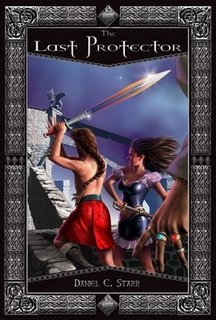
 Good news: The Last Protector is an official nominee in the "Global E-Book Awards" competition. (Yay!!)
Bad news: being "nominated" for a competition just means I did the paperwork correctly. It doesn't mean that any of their judges have yet read the book, or for that matter that Global E-Book Awards World Domination Headquarters has even received a copy. All that stuff comes later. (Aww...)
My past experience with book competitions (which all authors are encouraged to enter, as they are supposed to be marketing tools) is that competition follows these steps:
- The author fills out a form and sends it to the contest promoter. Along with some money, of course.
- Once the form has been found to be complete and correct (i.e., accompanied by the appropriate amount of money), the author or publisher sends the promoter a copy of the book.
- The author then waits to see what happens next.
And step 4... well, much of the time, for many authors, there is no step 4 beyond perhaps going to the contest website a few months later and discovering that some other book won the contest. And, of course, filing the receipt for the entry fee amongst the business expenses.
To its credit, the "Global E-Book Award" contest seems to be at least a bit different. For one thing, during "National Read an E-Book Week," they waived the entry fee. Second, they gave me this cool little badge to put on my website, saying that my book is officially a "nominee." And third, they gave my book a page on their site, which people who are perusing the site looking for interesting books might stumble across.
This third thing is where you come in, dear reader, should you wish to help out a struggling author (or, if you don't particularly want to help me, you may still want to help my publisher make a profit): go to the Last Protector page on the Global E-Book Award site, and register a vote by clicking on one of the ratings in that line of blue letter eeeee's just above the book blurb (it would be nice if you clicked on one of the more favorable ratings, of course). While the contest officials say the number of favorable votes won't determine who wins, they also say that the judges will be able to see the results of the voting. So... click away... and thanks much.
Friday, April 22, 2011
Passion of the Snowman
Today is the peculiarly named "Good Friday," the day in which we remember the story of one who came into this world in a way that was magical or perhaps miraculous, attracted a band of followers, led a procession into the city to the cheers of little children, met his demise saving others, was miraculously raised from the dead and ascended into the sky promising to return.
I'm talking, of course, about:

Well, who did you think I had in mind?
Seriously, it's almost creepy how this classic "secular" cartoon parallels the Easter story. The correspondence is so close that I've used this cartoon in a Sunday school class. I often wonder if the writer consciously set out to create a "Passion of the Snowman" tale, or if he just happened into it while figuring out how to stretch a three-minute pop song into a half-hour TV show.
There's no apparent religious content to the song "Frosty," and the 1954 black-and-white cartoon from UPA (once on YouTube but, alas, since removed for copyright reasons) depicts him as more a force of nature, a sort of winter free spirit who's out to have fun and not at all bothered by the knowledge that he'll soon melt:

But the Rankin/Bass half-hour show follows the life-of-Christ story almost incident-by-incident:
...from the magical "Happy Birthday!" (and let's not even start delving into what the magic hat might symbolize)

...through the Palm Sunday procession...

...to his sacrificial melting at the hands of Professor Hinkel...

...to his subsequent re-freezing (with Santa Claus doing a guest appearance as God)...

...to the final ascension, with the promise to return

Strange and heavy stuff for a secular cartoon about a talking snowman...
So, was this an intentional re-use of the Easter story? A coincidence? Perhaps the "bones" of the Passion story are so universal (maybe we all want to believe there's somebody in the world who'd sacrifice everything for us) that it just happened to work out this way. After all, it's been said that just about every novel, play or movie has some character who's identifiable as the "Christ figure." So it could be that any resemblance between Frosty and Jesus is just accident and should be taken as having no significance whatever. It's one of those things that we all must decide for ourselves.
That said, let me observe one other "secret message" in "Frosty." It's a well-known fact that cartoon characters, from Mickey Mouse to Homer Simpson, have three fingers and one thumb on their hands. True, there are a few exceptions, but it's a pretty established rule. And, as this frame from "The Simpsons" demonstrates, one exception occurs when the character is divine:

So, if three fingers means "human" and four means "divine," what do we make of this frame from "Frosty"?

Count the fingers: three (human) on the left hand (plus one thumb), but four (divine) on the right hand. Frosty is apparently both human and divine at the same time, which is of course one of the fundamental (if confusing at times) items of Christian doctrine. Hmm...
Saturday, March 5, 2011
The Return of Read An E-Book Week
Yep, it's National Read an E-book Week, March 6 through 12. In honor of the event, OmniLit is offering The Last Protector for a whopping 50 percent off, now through March 15! So if you're one of the people who wanders by this site for advice on motorcycle repair, and have been toying with the idea of maybe perhaps reading my novel, now's the chance to pick it up for half price. CLICK HERE to find out more about this deal!
My publisher, Twilight Times Books, has a bunch of other Read and E-book Week promotions going on as well--many books are marked down, and some are available for free--a few are available for free all week long, and there are daily free downloads as well. CLICK HERE to find out more about the free books.
One of the free-this-week books is How I Wrote My First Book: the Story Behind the Story, in which twenty authors (including yours truly) spin the epic tales of how we came to write our first books. CLICK HERE to find out more and read a sample chapter (not, alas, mine...).
Read an E-book Week only runs until March 13, and OmniLit's half-price offer on The Last Protector only runs through March 15, so get clickin' while there's still time!
Wednesday, February 16, 2011
Watson Wins Jeopardy

On the occasion of IBM's "Watson" computer beating two human "Jeopardy" champions (though it could not properly identify Chicago in the "Final Jeopardy" round), I note the following chronology:
- 1940s: computer power is measured in hundreds of operations per second, and we use computers to do things like crack the Enigma cipher and win World War II.
- 1960s: computer power just makes it into the millions of operations per second, and we use computers to put men on the moon and control the national telephone network.
- 1980s: computer power is comfortably in the tens of millions of operations per second, microchip technology crams these onto tiny chips, and we use them to put a phone in every pocket, so people can annoy each other while driving 60mph in a school zone.
- late 1990s: we break into the billions of operations per second, and use this power to render really realistic blood in first-person shooter video games.
- 2000s: computer power is now in the tens of billions of operations per second, and we use this power to win a TV trivia game show.
Conclusion: over time, the power of the computer multiplied by the usefulness of the application remains constant.
The logical extension is that when we finally do build a computer that matches the power of the human brain, all it will do is sit around, watch TV and play video games. Which might be a useful thing, if it frees us from those tasks.
Subscribe to:
Posts (Atom)